

Why Early Cricket Training in India Needs a Rethink?
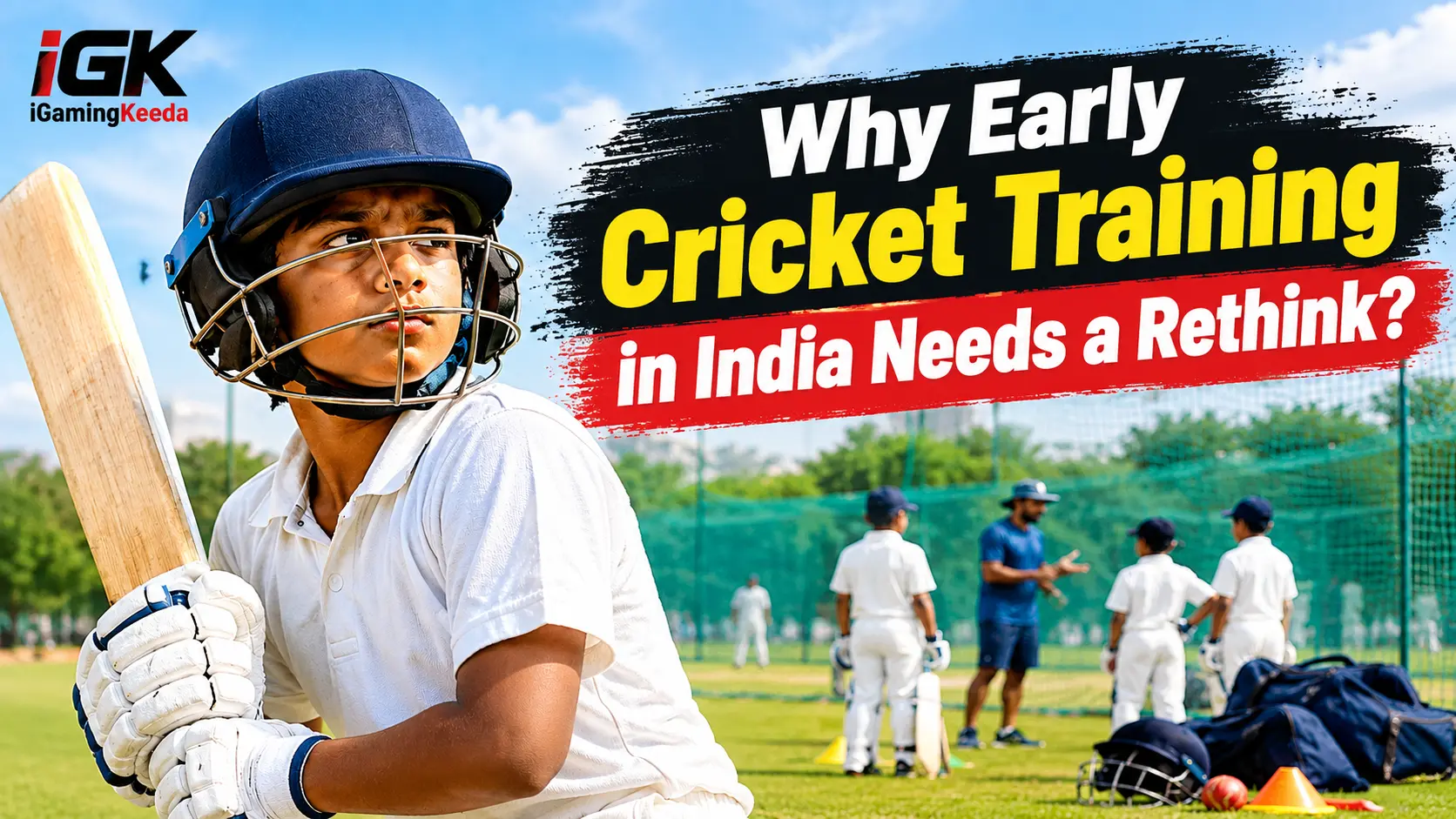
Vaibhav Sooryavanshi has given Indian cricket fans another remarkable teenage success story. At just 15, he took apart world-class bowlers in IPL 2026 and made his international debut, putting the spotlight on the possibilities available to exceptionally young cricketers.
His rise has also strengthened a growing belief among Indian parents: if a child starts playing cricket early enough, receives professional coaching and follows a disciplined routine, they might eventually reach the highest level of the game.
Across India, from metropolitan cities to smaller towns and rural communities, parents are enrolling children in cricket academies at increasingly young ages. Some want their children to enjoy the sport and develop useful skills. Others see cricket as a potential career, a route to financial stability or an opportunity to achieve ambitions they could not fulfil themselves.
The Indian Premier League (IPL) has made this dream more attractive. With 10 franchise teams, state leagues and lucrative tennis-ball tournaments creating additional opportunities, aspiring cricketers have more routes towards recognition and professional success than they did in earlier generations.
But there is an important question that deserves attention: Does starting competitive cricket at a very young age improve a child’s chances of becoming a successful professional, or are parents placing too much importance on the exceptional achievements of teenage stars?
Sooryavanshi’s success is worth celebrating. However, his journey should not automatically become the blueprint for every young cricketer in India. Developing a player requires more than identifying talent early and increasing training hours. It also requires patience, appropriate coaching, physical preparation and an environment in which children can learn without feeling that every performance determines their future.
How Vaibhav Sooryavanshi Has Intensified the Search for India’s Next Cricket Superstar?
The search for young cricketing talent did not begin with Vaibhav Sooryavanshi. Sachin Tendulkar made his Test debut at 16, demonstrating decades ago that a teenager could enter international cricket and build an extraordinary career.
What has changed is the environment surrounding Indian cricket.
During Tendulkar’s early years, the national team was the primary destination for players seeking national recognition and the financial rewards associated with cricket. The IPL has since transformed the professional landscape, creating opportunities for young players to make a name for themselves through franchise cricket.
Alongside the 10 IPL teams, state leagues and lucrative tennis-ball tournaments have expanded the ecosystem in which aspiring cricketers can compete. A young player no longer has to view the national team as the only possible route to recognition.
Sooryavanshi has become the face of this accelerated demand for teenage talent. Following his success, at least one North India-based IPL franchise has reportedly begun actively searching for its next young cricketing sensation. His name has become a reference point in that hunt, potentially with long-term brand growth also in mind.
For franchises, discovering a young player with exceptional potential can offer both sporting and commercial opportunities. For families, however, the same development can create the impression that identifying talent early is essential to securing a child’s future.
That is where the distinction between opportunity and expectation becomes important.
A young player watching Sooryavanshi may feel inspired to practise, improve and enjoy cricket. A parent watching the same performances may start thinking about academy admissions, professional contracts and the possibility of an early breakthrough.
Neither ambition nor structured training is inherently wrong. The problem begins when a rare success story is treated as proof that every promising child should follow an equally intensive path.
Ayush Mhatre and the appeal of early success
Ayush Mhatre‘s emergence has added to the excitement surrounding teenage cricketers. At 17, he attracted attention while playing for Chennai Super Kings shortly before Sooryavanshi’s IPL debut. Videos of Mhatre playing cricket at six in Mumbai’s maidans subsequently circulated on social media.
Such stories create a compelling narrative. A child starts playing early, develops through training, receives opportunities and eventually reaches professional cricket.
Parents naturally want to understand what helped these players succeed. Yet the visible details of a player’s childhood rarely provide a complete explanation of their eventual achievements.
Starting young may provide opportunities to learn the game, but it does not establish that early competitive specialisation is necessary for success. Nor does it mean that a training routine suitable for one exceptionally talented player will work equally well for thousands of other children.
Indian women’s cricket offers another perspective. Shafali Verma, Smriti Mandhana, Deepti Sharma, Richa Ghosh and Jemimah Rodrigues are among the players who made their international debuts as teenagers. Importantly, these players did not enter formal training and competitions early in the same way encouraged by the current academy-driven trend.
Their journeys underline a useful distinction: beginning to enjoy a sport at a young age is not the same as entering an intensive competitive system at that age.
Sooryavanshi and Mhatre should inspire young players to explore their potential, not become standards against which every child is judged. Exceptional talent deserves recognition, but the pathway to developing that talent needs to account for individual differences.
Why Are Indian Parents Sending Their Children to Cricket Academies So Early?
The motivations behind early cricket training vary across India’s economic groups, although the desire to provide children with better opportunities is common.
For many lower- and middle-income families, sporting success represents a possible route to financial stability and social mobility. A successful sporting career may lead to professional opportunities or a government job, making cricket an attractive prospect for families looking for a better future.
Among higher-income urban households, the motivations can be different. Some parents want their children to achieve the cricketing ambitions they could not fulfil themselves. Others see professional sport as an ambitious career path that could provide recognition and financial rewards.
Peer pressure adds another dimension.
Consider Aditya Singh, a 33-year-old software engineer from Gurugram whose name has been changed. He wants to be an involved parent to his two-year-old son. After spending months consuming parenting advice on Instagram, he has become convinced that developing good habits early can produce long-term benefits.
He plays recreational cricket with his son using a plastic bat and ball. Although Aditya has little personal interest in cricket, he notices that the child appears to have a decent bat swing and a sense of timing. He begins considering an academy, seeing it as a way to encourage physical exercise, develop skills and provide a structured environment while the parents work.
More significantly, he believes cricket could become a productive route to his son’s future professional success.
Sooryavanshi’s rise reinforces that belief. Meanwhile, Aditya’s friends have already enrolled their children in different sports academies. Rather than questioning whether structured competition is necessary at such a young age, he wonders whether exposing children to multiple sports might confuse them.
Aditya’s thinking reflects a wider pattern. Kalna Shukla, an Ahmedabad-based sports psychologist, observes that parents themselves can become victims of peer pressure.
When other families begin investing in academy training, parents may worry that their children will fall behind if they do not follow the same path.
This can turn a decision that should be based on a child’s interests into a race between families.
When learning cricket becomes a search for the next Virat Kohli
Chetan Jadhav, a Navi Mumbai-based coach of Abhigyan Kundu, who won the Under-19 World Cup for India at 16, says parents have approached him seeking admission for children as young as four.
The expectations sometimes go far beyond teaching a child to play. Parents want coaches to turn their children into the next Virat Kohli.
Similar ambitions surround Sachin Tendulkar, MS Dhoni and now Vaibhav Sooryavanshi.
The problem is not that parents dream of their children becoming successful cricketers. Ambition can motivate families to provide opportunities and encourage consistent practice. The concern is that a child may be assigned a professional identity before they have had enough time to discover whether they genuinely want to pursue the game.
A promising bat swing, enthusiasm during practice or early success in junior cricket can indicate potential. None of these qualities guarantees a professional career.
At two, four or eight years old, a child may not even fully understand what it means to become an international cricketer. The responsibility therefore falls on parents and coaches to distinguish between encouraging an interest and imposing an ambition.
Winning Is Not the Main Reason Children Play Sport
One of the most important considerations in junior cricket is the difference between what adults want from sport and what children actually enjoy about it.
Research into children’s sporting motivations has repeatedly found that winning ranks much lower in their priorities than adults often assume. Winning has ranked between eighth and twelfth, while reasons such as being with friends, having fun, belonging to a team and doing something they feel good at rank considerably higher.
This matters because competitive cricket can quickly change the way a child experiences the game.
A youngster may initially enjoy batting because hitting the ball is exciting. They may want to bowl because their friends are doing so or enjoy fielding because it makes them part of a team.
As training becomes more structured, adults may begin measuring progress through runs, wickets, selections, batting positions and tournament results.
Those measures have a place in competitive cricket. But if they become the only way to judge a child’s experience, the original enjoyment of playing can disappear.
What is the right age for a child to start playing cricket?
There is no single answer that can be applied to every child simply because they show an early interest in cricket.
Shukla explains that children’s interest in sport often begins with curiosity. They imitate the people around them, experiment with an activity and gradually develop an interest as they enjoy it or receive encouragement.
Parents need to understand the reason behind that interest.
Does the child want to play because their friends are involved? Is cricket a way to spend quality time with a parent? Do they enjoy the activity for its own sake? Or are they showing a sustained desire to pursue the sport seriously?
These differences matter more than an assumption that earlier academy admission must be better.
Sports offer children benefits beyond the possibility of becoming professional athletes. They help develop motor skills, social interactions, relationships, an understanding of authority and the ability to participate in a team. For many children, playing sport also provides an intrinsic sense of joy.
Those benefits remain valuable even when a child never progresses beyond recreational cricket.
In my view, parents should first focus on helping children develop a positive relationship with the game. Structured coaching can support that process, but it should not automatically replace informal play, exploration or the freedom to decide how seriously to pursue cricket.
How Parental Pressure Can Affect Young Cricketers?
Pressure does not always begin with an explicit demand to win.
Sometimes it develops gradually when parents notice that a child is disciplined, punctual, intelligent or capable of learning quickly. Those qualities can lead adults to expect consistent progress, even when the child is still exploring the sport.
Shukla points out that children are highly sensitive to adults’ emotions. Even when parents do not directly express disappointment, youngsters can recognise that their performances matter greatly to them.
A child may consequently begin worrying about whether they are doing enough, falling behind their peers or letting their parents down.
In cricket, such concerns can appear in everyday situations. A parent may question why a child was not selected for a particular team, why a coach changed their batting position or why another youngster appears to be progressing faster.
The article describes a parent becoming anxious because their 10-year-old child, who usually batted at number three, was sent in at number five. The child’s routine had become so closely monitored that a change in batting order was enough to cause concern.
For a coach, batting positions are part of managing a team and giving players different experiences. For a parent who sees every decision as a measure of progress, the same change can become a source of anxiety.
This difference in perspective can turn ordinary cricketing decisions into emotional events.
The problem with treating training as an investment
Parental investment is not always financial.
Shukla notes that taking children to training and collecting them afterwards can itself feel like an investment of effort. Parents who organise their lives around a child’s cricket may begin expecting results in return.
Those results might include improved performances, selection, recognition or evidence that the child is moving towards a professional career.
But development does not always follow a predictable path. A player may improve quickly, struggle for a period, lose interest or discover that another activity suits them better.
When parents interpret these changes as a failure to justify their efforts, the disappointment can affect family relationships.
Paddy Upton, a mental conditioning coach who has worked with the Indian cricket team and several IPL franchises, has described similar concerns in South Africa. In his blog, he writes that 70% of the 40 million children who start playing sports at school quit by the age of 13. He identifies coaches and parents as the two main reasons and notes that 36% of children blame their parents.
These are the figures Upton cites for the South African context, not estimates for Indian children.
His broader point is that winning can become an adult and ego-driven agenda rather than something the child values in the same way. Children may notice when parents become visibly happy after a good performance but unhappy after a poor one.
When affection or recognition appears linked to winning, the child can begin to associate sporting performance with parental approval.
A young cricketer should be able to play a poor innings, lose a match or miss selection without feeling that they have disappointed their family as a person. Learning from failure is part of cricket, and children need room to experience it without turning every setback into a judgement about their worth.
Early Specialisation Can Create an Identity Crisis
One of the biggest risks of building a child’s life entirely around cricket is that the sport can become their only source of identity.
Early specialisation often involves dedicating most available time to one activity. For a young cricketer, this can mean spending hours training, competing regularly and organising friendships and daily routines around the game.
The problem is not simply that the child spends a lot of time playing cricket. It is that other parts of their life may never receive enough attention to develop independently.
Friendships outside the sport, education, hobbies and family experiences can all help children understand themselves beyond their sporting ability.
Without that balance, a serious injury, a missed selection or the end of a cricketing ambition can feel like the loss of an entire identity.
Vishnu Salunkhe’s experience shows the cost of a single-minded cricketing ambition
Vishnu Salunkhe, whose name has been changed, joined a cricket academy at four. His talent was evident, and by 10 he had moved to one of Mumbai’s premier schools for cricket.
His parents relocated closer to the school to support his development. His academics soon took a back seat, and he began playing for one of Mumbai’s premier clubs.
At 17, an injury kept him away from cricket for several months. He subsequently failed to make Mumbai’s Under-19 team. Distraught and believing that the selectors had shown bias, he abandoned the sport.
The consequences extended far beyond his playing career. He cut himself off from friends, became bitter and abusive towards his parents, and blamed them for his frustration to the point that they had to leave the house and let him be alone.
For years, his life had revolved around one objective: becoming an India cricketer. His sacrifices and those of his family were directed towards that goal. His friendships and social system were also built around cricket, leaving little room for other interests.
Once that identity disappeared, he was left with a sense of shame and failure. He now stays confined inside the house, avoids social interactions and spends his time playing video games.
Vishnu’s experience demonstrates how difficult it can be to deal with sporting disappointment when almost every part of life has been organised around one ambition.
Not every child who leaves competitive cricket will experience these consequences. However, his story illustrates the risks of leaving a young person without other interests, relationships or sources of self-worth.
Why does a young cricketer need an identity beyond the game?
Mumbai-based sports psychologist Sanika Divekar explains that identity develops around the ages of eight to 10, according to the developmental models she references. By young adolescence, children who have specialised heavily in sport may begin to see themselves primarily as athletes.
When self-worth becomes dependent on being a cricketer, sporting setbacks can affect the person’s wider sense of identity. If they have to leave the game, they may struggle to find another source of confidence or belonging.
The same concern can be seen in the example of Ronda Rousey, one of the leading women in mixed martial arts. After losing a UFC bout for the first time to Holly Holm, Rousey experienced thoughts of taking her own life. Sitting in a medical room after being knocked out, she questioned who she was if she was no longer the champion she had always known herself to be.
Her experience illustrates how deeply an athlete’s identity can become connected to winning and sporting status.
Upton has also argued that some Indian cricketers put all their eggs in one basket from an early age. Every moment outside school becomes cricket, leaving them frightened to leave the only life they know. He contrasts this with players elsewhere who may participate in other sports, maintain hobbies or build relationships outside cricket.
These observations do not mean every Indian cricketer lacks interests beyond the game. They highlight the risks of a development system that leaves too little room for life outside sport.
For young players, a broader identity can provide perspective when results do not go their way. A missed selection may be disappointing, but it need not erase their sense of who they are.
Does Starting Cricket at a Young Age Guarantee Professional Success?
Early training can give a child more opportunities to learn the fundamentals of cricket. But there is an important difference between beginning a sport young and specialising in competitive training before the child is ready.
The assumption that early success predicts long-term achievement is not supported by the evidence discussed here.
Paddy Upton has argued that success before the age of 13 has no statistical bearing on how successful a child will be by 18. The point is not that early achievement is meaningless, but that it cannot reliably determine a player’s future on its own.
American tennis coach Wesley Zhang has expressed a similar view based on his experience in junior tennis. Zhang said he was ranked around 20 in US junior tennis and spent years around youngsters whom others expected to become future stars.
Looking back, he observed that many players who eventually succeeded had not been on those early lists. Others who dominated junior competition burned out and quit.
His explanation is that a young player who wins easily may not always be required to solve difficult problems. Early physical advantages, including size and strength, can make victories come more easily. When other players catch up physically, those advantages may disappear.
Players who have had to work through losses and difficult matches, meanwhile, may have developed problem-solving skills that become more valuable as the standard rises.
Zhang used Ben Shelton, the 22-year-old who reached the final of the 2026 US Open, as an example. He recalled that Shelton had been a solid junior player but was not widely viewed as a future world-class star by those watching him at the time.
The lesson is not that struggling players will necessarily become more successful than dominant juniors. It is that early rankings and results provide an incomplete picture of long-term potential.
Why Sooryavanshi’s pathway cannot become a universal formula?
Sooryavanshi’s success and Ayush Mhatre’s emergence show that early achievement can lead to significant opportunities. But exceptional cases do not establish a formula for developing every player.
Prashant Shetty, a Mumbai-based coach who has worked with Prithvi Shaw and Jemimah Rodrigues, says parents sometimes approach him hoping he will turn their eight-year-olds into the next Sachin Tendulkar. He believes coaches have a responsibility to decline such requests when the expectations are inappropriate.
Shetty’s experience with Shaw is particularly relevant. Shaw began playing competitive cricket at seven, but Shetty argues that players with extraordinary talent are exceptions. Their training still needs to be managed carefully, and their experiences cannot be treated as the right approach for everyone.
That is the key distinction between identifying potential and predicting a career.
A child may show remarkable ability at an early age. The responsibility of parents and coaches is to help that ability develop without assuming that early success guarantees a place at the top.
The Physical Risks of Early Cricket Specialisation
The concerns surrounding early specialisation are not limited to mental health and motivation. Intensive training can also create physical risks when the demands placed on a young player exceed their capacity.
Upton points to research suggesting that specialising in one sport too early, around the ages of 13 to 15 depending on the sport, can be associated with impaired learning, boredom, overuse injuries and burnout.
Divekar raises similar questions about the physical consequences of intensive training. Referring to research on early specialisation, injuries and career outcomes in football, she highlights the importance of matching training demands with appropriate fitness, nutrition, rest and recovery.
For cricket academies, this means that the volume and intensity of training need to be considered alongside a player’s age and physical development.
A youngster’s enthusiasm or discipline does not automatically establish that their body is ready for the demands of intensive competition.
Why rest, nutrition and recovery matter?
Training places demands on the body. If the programme is too intensive or recovery is inadequate, a young player may struggle to manage those demands.
Divekar emphasises that the fitness, nutritional support, rest and recovery provided to an athlete must be appropriate for the physical workload. She also raises questions about whether intensive training can affect normal biological development.
These concerns are especially relevant when parents expect children to attend training every day and coaches are under pressure to produce visible improvements.
The goal should not be to maximise the number of hours a child spends practising. It should be to provide training that supports sustainable development.
Tennis offers several cautionary examples. Martina Hingis, Jennifer Capriati and Justine Henin started training at four, reached the summit of their sport in their teens and experienced burnout or injuries in their 20s. Tracy Austin and Bjorn Borg are also cited as examples of the challenges associated with early specialisation.
Recognising these concerns, the WTA and ATP have introduced age-related rules and caps on tournament participation. Players under 14 must also fulfil educational requirements and complete compliance courses alongside their athletic training.
These examples do not establish that early training inevitably causes injury or burnout. They show why sporting development needs safeguards that account for young athletes’ physical and educational needs.
Outside sports such as gymnastics, where early specialisation may be necessary, Divekar says there is not yet data establishing that specialising early produces better results at the elite level.
For cricket, that is a reason to be cautious about treating intensive training at the youngest possible age as a guaranteed advantage.
What Indian Cricket Academies and Coaches Need to Understand?
The growing demand for young talent places considerable responsibility on coaches. Parents may arrive with ambitions of producing the next Tendulkar, Kohli, Dhoni or Sooryavanshi, but coaches must decide whether those expectations are appropriate for the individual child.
A good development environment should recognise that children enter cricket for different reasons and progress at different rates.
Some may eventually pursue professional cricket. Others may prefer recreational participation. A child who does not become an international player has not necessarily failed, and an academy’s value should not be measured exclusively by the number of professional cricketers it produces.
Learning should come before expectations of results
Young cricketers need time to develop their batting, bowling, fielding and understanding of the game.
A player may be improving their technique or learning to manage difficult situations even when their match results are inconsistent. Those developments matter, although they may not provide the immediate signs of progress that anxious parents want to see.
Coaches should therefore be prepared to explain the purpose of training and help parents understand that development involves more than runs, wickets and selection.
They should also be willing to reject inappropriate expectations. Shetty believes it is the responsibility of coaches to decline requests from parents who want their young children turned into superstars.
This does not mean discouraging talented youngsters. It means providing the right support without promising an outcome that no coach can guarantee.
Children need time away from competitive cricket
Shukla describes how some 10-year-olds have schedules busier than adults, with no breaks or family holidays.
Such routines raise concerns about whether children have sufficient time to rest, maintain friendships and explore other interests. A child can remain committed to cricket without having every moment organised around it.
For parents, allowing time away from training should not automatically be interpreted as weakening ambition. Rest and balance are part of healthy development, while other activities can help children build relationships and interests that remain valuable throughout life.
A cricketing career can be demanding, and players need to learn how to handle pressure. But that does not mean every childhood experience should be organised around preparing for professional competition.
What the Future Holds for India’s Search for Young Cricket Talent?
The IPL is only 18 years old, yet it has already reshaped how many Indian families imagine sporting success. Its franchises provide a platform for young cricketers to gain recognition, while state leagues and lucrative tennis-ball tournaments offer additional opportunities to participate and compete.
Sooryavanshi’s success has added momentum to this trend. The demand for the next teenage superstar is growing, and the commercial and professional opportunities surrounding Indian cricket make early talent identification increasingly attractive.
However, the long-term consequences of widespread early specialisation remain uncertain.
Indian cricket does not currently have the age-related tournament restrictions and educational requirements described in relation to tennis, and no comparable measures are identified as being in the pipeline. In this environment, parents, coaches and academies have a particularly important role in making sure that ambition does not become excessive pressure.
The available evidence does not prove that every child who specialises early will experience burnout, nor does it establish that children who start later will necessarily enjoy more successful careers. Equally, the achievements of teenage stars do not prove that early competitive specialisation is the best route for every aspiring cricketer.
The more useful approach is to recognise that development depends on several factors, including talent, motivation, coaching, physical readiness and the ability to respond to setbacks.
India needs pathways that allow talented children to progress. It also needs environments in which youngsters can explore cricket without feeling that they must justify their parents’ sacrifices through professional success.
The search for young talent should be about identifying and nurturing potential, not predicting a child’s entire future before they have had time to grow.
Final Verdict: India’s Next Cricket Superstar Needs More Than an Early Start
Vaibhav Sooryavanshi’s rise is an exciting development for Indian cricket. His achievements at 15 have captured attention and shown what exceptionally talented young players can accomplish in the modern game.
But the search for the next Sooryavanshi should not become a race in which children are pushed into intensive competition before they have had time to discover their interests and develop at their own pace.
Starting cricket early can provide opportunities to learn the game. It cannot guarantee professional success. Intensive training may help a player develop, but it also needs to account for physical readiness, recovery, mental well-being and the child’s motivation to continue.
Parents should encourage their children’s ambitions without making sporting results a condition of approval. Coaches should nurture talent while recognising that extraordinary early achievers are exceptions, not templates for every young player.
Most importantly, children need the freedom to enjoy cricket, make mistakes, experience setbacks and build identities beyond the boundary.
The next Vaibhav Sooryavanshi may already be playing cricket somewhere in India. But finding that player should never require treating every child as a future superstar. Indian cricket’s challenge is not simply to produce more teenage sensations. It is to develop an environment where young players can pursue their potential without sacrificing their childhood, health or sense of self in the process.

Relevant news
Mitchell Starc’s Day of Extremes in Cape Town: How Australia’s Fast Bowler Turned the Tide
Mitchell Starc experienced two contrasting spells on the same day in Cape Town. First, South…
Harpreet Brar’s seven-year IPL wait for a settled role
For seven IPL seasons, Harpreet Brar has remained one of Punjab Kings' few constants. The…
Why India Missed the Women’s T20 World Cup Semifinals?
India entered their final league match knowing only a win against Australia would keep their…
India’s Road Gets Tougher as South Africa Boost Semifinal Hopes
South Africa's victory over India has made the race for the semifinals much more interesting…

The Shot That Defined Kane Williamson Better Than Any Century
There are many reasons why cricket fans admire Kane Williamson. There were his beautiful cover…
Four Reasons Afghanistan Struggled Against India in the One-Off Test
Afghanistan came into their one-off Test against India in New Chandigarh hoping to show how…