

India won the series in New Zealand, but how close are they to finding their perfect ODI side?
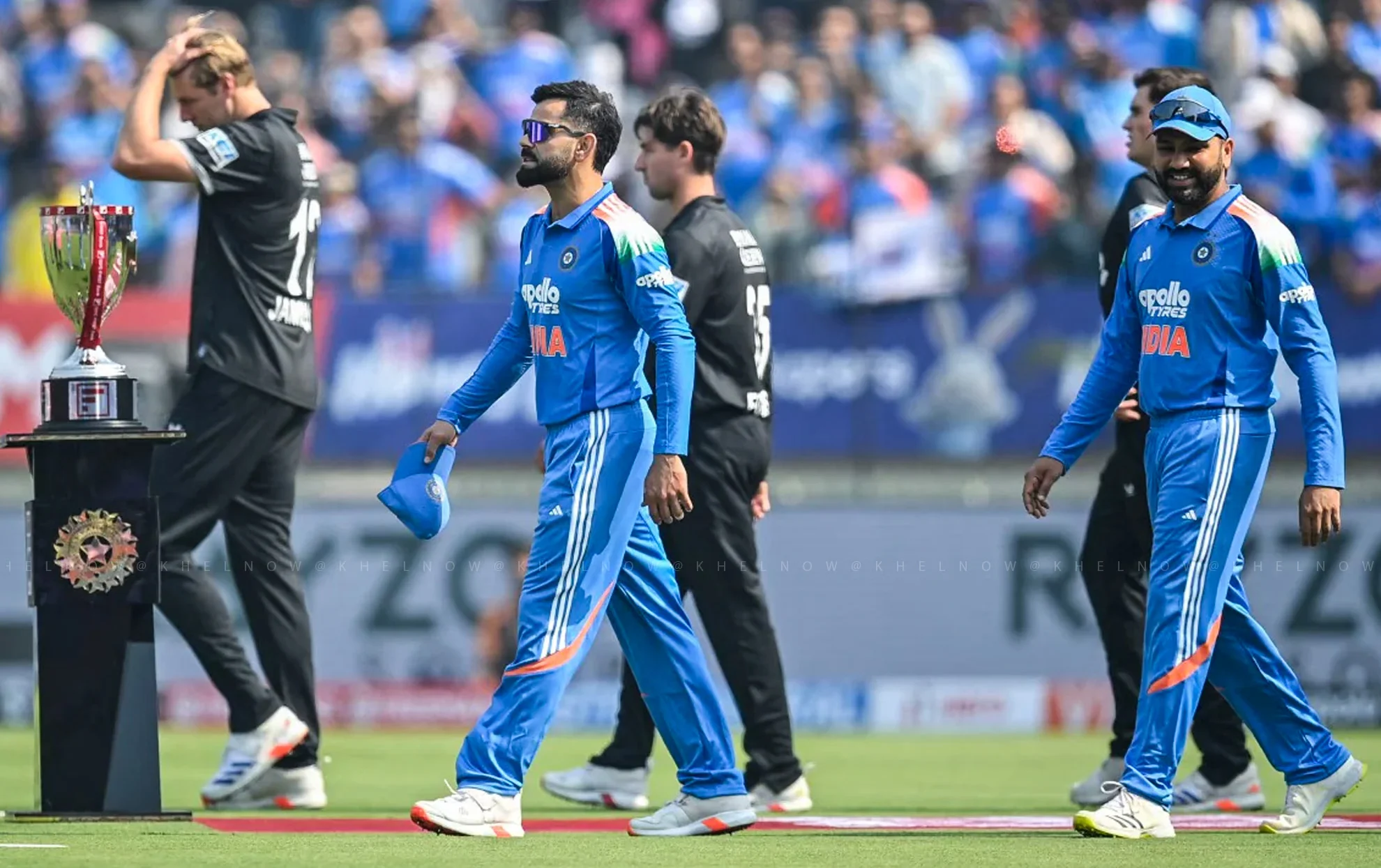
India won the series in New Zealand. So shouldn’t they be leaving Tauranga with more answers than questions?
In Tauranga, where the Māori word means resting place, New Zealand’s seven-year streak was finally buried. India secured both legs of the white-ball tour, registering their second consecutive ODI series victory after the setback in England. For a team ranked No. 1 in the format, it was an important result as the road towards the next World Cup grows shorter.
Shreyas Iyer, who led the side in the absence of Shubman Gill, described the achievement as a “great achievement” before lifting the trophy. And he was entitled to celebrate. Winning in New Zealand is not something India have managed regularly, particularly in bilateral cricket.
But winning a series and building a World Cup-ready team are two different exercises.
For all the positives, India’s tour also exposed familiar weaknesses. The batting struggled against movement, the fielding was unreliable, and the team continued to shuffle its combinations despite having previously insisted that experimentation was no longer a priority.
That is where the more interesting conversation begins. India got the result they wanted, but did they get the clarity they needed?
The pace attack finally looks like a settled strength
Before leaving for New Zealand, Gill had made his intentions fairly clear. With the World Cup approaching, there was little time left for experimentation. He wanted India to play with their first-choice players and establish a core that could carry them through the tournament.
That thinking was understandable, especially after the West Indies series, where the absence of several key players left the bowling attack looking short of quality. The replacement options struggled on flat home pitches, making the bowling department arguably India’s most pressing concern.
New Zealand offered some encouraging answers.
The inclusion of Arshdeep Singh and Gurnoor Brar gave the pace attack a different dimension. Arshdeep’s left-arm angle and ability to generate early swing provided something India could not easily replicate with their other seamers. In conditions that offered assistance, his presence became particularly valuable.
Brar, meanwhile, brought a different kind of threat. His ability to attack with the hard length, extract natural extra bounce and make batters adjust their shapes gave India an additional weapon.
It was not simply about individual performances. The cohesion between the seamers, even without Jasprit Bumrah, made the attack look considerably healthier.
The numbers from the series underline that improvement.
Seamers bowling back of a length or shorter in the series
| Metric | India | New Zealand |
| Wickets/Runs | 16/275 | 14/223 |
| Average | 17.18 | 15.92 |
| Strike rate | 23.50 | 18.10 |
| Economy | 4.37 | 5.26 |
| False shot percentage | 28.10 | 23.00 |
New Zealand’s seamers were slightly more effective in terms of average and strike rate, but India’s economy rate was better, and they generated a higher false-shot percentage.
There were other encouraging developments, too. In more helpful conditions, Auqib Nabi and Anshul Kamboj looked considerably more effective, offering useful reinforcements and giving the selectors more options to consider.
Perhaps the most revealing indication of India’s pace-bowling improvement was how little they needed their spinners. India did not have to introduce spin until the 36th over of New Zealand’s chase in the fifth ODI.
That is a significant development for a team that has often relied heavily on spin to control the middle overs.
And yet, if the bowling was one of the clear positives, the batting was an entirely different story.
A batting unit that never quite found its feet
After the series, Iyer made an interesting observation: “This wasn’t a series for batsmen.”
The numbers supported him.
Early movement had a debilitating effect on both batting lineups. Apart from the fourth ODI, when New Zealand crossed 300, there were five combined instances of either side being bowled out for fewer than 200.
Not a single Indian batter managed to aggregate even 100 runs across the series.
India’s top seven recorded a combined average of 19.16, their second-lowest in an ODI series consisting of at least four matches.
Two of India’s rain-affected chases were eventually completed through DLS targets, but not without batting collapses along the way. Those victories counted, of course, but they also made it difficult to overlook the fragility underneath.
The defeat in Mount Manganui was perhaps the clearest example.
India suffered their second-biggest defeat by runs after being bowled out for just 89. Iyer attributed the collapse to excellent New Zealand bowling and India’s failure to adjust to the changing nature of the pitch under lights.
Two days later, batting under the sun, India managed to push that total to 209.
The difference was noticeable. The conditions had changed, but so had the challenge of reading them.
There was no single bowling formula that exposed India throughout the series. Matt Henry troubled the Indian batters in Mount Manganui by moving between fuller deliveries and good-length balls. A week before that, New Zealand had caused problems by repeatedly attacking the short and back-of-length channels.
Different lengths, different methods, similar results.
After India’s 89 all out, head coach Gautam Gambhir openly highlighted the team’s concerning inability to adjust to what he called “alien” conditions.
It was an uncomfortable observation, particularly because Gambhir also believes these conditions resemble what India could encounter at the World Cup.
There is, however, an interesting difference in how the team management and players appear to view that challenge.
Gambhir’s comments suggested that India needed to learn from the conditions they had encountered. Iyer was considerably more cautious when asked about the lessons ahead of the marquee tournament.
“We’re in New Zealand, we can’t compare with South Africa. We don’t know what will happen. There’s still a year to go. The weather will be different,” he said.
He then returned to the broader assessment: “Batting did not work, neither for them, nor for us. In bowling, both them and we did well.”
Both arguments have some merit. Conditions in New Zealand cannot automatically be treated as a template for South Africa. But if the coaching staff sees similarities, shouldn’t India at least take the opportunity to examine why their batters struggled?
Winning a series is one thing. Understanding the reasons behind repeated batting failures is another.
Kohli and Rohit’s New Zealand farewell was not quite the one expected
Much of the pre-series attention was naturally centred on India’s two most experienced batters, Virat Kohli and Rohit Sharma.
Both have now featured in four bilateral tours of New Zealand. No other Indian players have appeared in as many bilateral matches in the country.
Their experience was supposed to provide a degree of stability to a batting lineup that has been searching for consistency.
Kohli delivered an excellent anchoring performance in the first chase, showing that he could still control an innings in difficult conditions. But he failed to fire in the following three matches.
Rohit had an equally disappointing series, crossing double figures only once.
For two players whose experience and understanding of international conditions remain among India’s biggest assets, the returns were underwhelming.
There was also the possibility that this could have been their last bilateral tour of New Zealand. If so, it was hardly the farewell either player would have wanted.
Of course, one difficult series does not suddenly change the value of two enormously experienced cricketers. Their careers, particularly in ODIs, cannot be judged through a handful of matches.
But India are approaching a World Cup cycle in which every role needs to be understood clearly. Experience matters, but so does current form, and the selectors will eventually have to balance the two.
The top-order combination remains a work in progress
Perhaps the most confusing part of India’s selection planning was what happened around the top order.
Gill had spoken about the need to avoid experimentation and establish a first-choice combination. Yet he and KL Rahul did not feature in the final two matches.
Their absence forced India to alter the structure of the top order once again.
Ishan Kishan, who has already been used everywhere between No. 3 and No. 6 this year, continued to offer flexibility. That is a useful quality, particularly when injuries and availability force changes.
But flexibility can also become a problem when it prevents a player from establishing a permanent role.
Ruturaj Gaikwad, meanwhile, became India’s fourth opening option of the year when he filled in for Gill.
Four opening options in a single year suggest that the position is still far from settled.
And then there is Yashasvi Jaiswal.
Despite being overlooked for the ODI series against New Zealand, Jaiswal produced consecutive hundreds in the shadow ‘A’ first-class series. His performances made the selection discussion even more interesting.
Shouldn’t India have a clearer idea of their backup opener by now?
Perhaps the management has its reasons. It may prefer experience, believe certain players offer a better tactical fit, or want to give existing combinations more time. But from the outside, the hierarchy remains difficult to understand.
The larger problem is that India appear to be approaching the final stages of their World Cup preparation without a clearly established top-order backup structure.
India’s middle order has a home-and-away problem
The concerns do not end with the opening combination.
India’s middle order, covering positions four to seven, has shown a particularly sharp difference between its performances at home and away since the Champions Trophy 2025.
India’s middle-order performance (positions 4-7) since Champions Trophy 2025
| Metric | Home | Away |
| Matches | 12 | 11 |
| Runs | 1,146 | 764 |
| Average | 47.75 | 24.64 |
| Strike rate | 110.72 | 79.58 |
| Hundreds/Fifties | 4/4 | 0/4 |
These numbers are difficult to dismiss as a small difference.
At home, India’s middle order has averaged 47.75 while scoring at a strike rate of 110.72. Away from home, the average falls to 24.64 and the strike rate drops to 79.58.
The contrast is even more apparent in the hundreds column. The middle order has registered four centuries at home and none away.
This does not necessarily mean India’s middle-order players lack ability. Conditions, opposition quality and match situations all influence batting returns. But the scale of the difference suggests that the team has not yet developed the same level of adaptability outside familiar conditions.
And that is precisely the quality India will need in a World Cup played away from home.
A tournament does not offer the comfort of playing every match on familiar surfaces. Teams have to adjust quickly, sometimes within the same game, and the middle order is often where those adjustments become most important.
India have shown what they can do when conditions suit them. The bigger question is whether they can reproduce that standard when they do not.
The fielding department has become another concern
If the batting was disappointing, India’s fielding offered very little relief.
Nine dropped catches and 16 misfields summarised a particularly poor series. Their catching efficiency stood at 75 per cent, while New Zealand performed better across every fielding metric.
The fourth ODI provided the most obvious example of how costly those mistakes could become.
Will Young received two early reprieves before going on to score a match-defining 125. Those dropped chances gave New Zealand the opportunity to build an innings that eventually proved decisive.
The mistakes were not limited to inexperienced players, either. Kohli, Rohit and Gill were among those who dropped catches, while younger players such as Yash Thakur also found themselves on the wrong side of the fielding scrutiny.
That is a worrying combination for a team that needs its senior players to set standards in every department.
Fielding statistics among Full Member teams since 2025
| Team | Matches | Catches | Drops | Catch efficiency | Misfields |
| Ireland | 15 | 77 | 13 | 85.5% | 74 |
| South Africa | 23 | 114 | 22 | 83.8% | 98 |
| New Zealand | 35 | 225 | 45 | 83.3% | 166 |
| Pakistan | 28 | 129 | 29 | 81.6% | 120 |
| Australia | 25 | 136 | 32 | 80.9% | 109 |
| England | 30 | 160 | 44 | 78.4% | 131 |
| Bangladesh | 25 | 131 | 36 | 78.4% | 123 |
| Zimbabwe | 14 | 76 | 22 | 77.5% | 87 |
| Sri Lanka | 25 | 100 | 31 | 76.3% | 97 |
| Afghanistan | 16 | 73 | 23 | 76.0% | 101 |
| India | 30 | 158 | 53 | 74.8% | 150 |
| West Indies | 23 | 100 | 44 | 69.4% | 109 |
India’s 74.8 per cent catching efficiency is the second-lowest among the Full Member teams listed, ahead of only West Indies.
The 53 dropped catches are particularly concerning. No other team in the table has dropped as many.
There is another layer to this problem. India have already faced scrutiny over their fielding after similarly disappointing performances on the UK tour. Now, even with a new fielding coach, the department still looks like a work in progress.
A new appointment can bring fresh methods and standards, but improvement is ultimately measured on the field. And nine dropped catches and 16 misfields in one series are not the signs of a settled unit.
The bigger question: what exactly is India’s World Cup blueprint?
It is tempting to treat the New Zealand series as an isolated exercise. India won, their pace attack looked better, and several players gained valuable exposure.
But the larger context makes the remaining questions more important.
The World Cup cycle is supposed to be the period when teams narrow down their combinations, identify their strongest players and establish clear roles. India had already indicated that the experimentation phase was coming to an end.
Yet the New Zealand tour showed that several positions remain uncertain.
The backup opening option is not clear. The middle order performs very differently at home and away. The fielding standards are below those of most competing Full Member sides. And the team is still working out how to respond when conditions move away from what its batters are accustomed to.
There are also two major absences that cannot be ignored: Jasprit Bumrah and Hardik Pandya.
Both are among India’s most important white-ball matchwinners. Bumrah offers a level of control and wicket-taking ability that is difficult to replace, while Hardik provides the balance of a seam-bowling all-rounder and a powerful batting option.
India’s current squad has not necessarily identified suitable replacements for either player.
That does not mean they will miss the World Cup or that India should start planning without them. But tournament preparation also involves planning for the possibility that key players might not be available.
A team cannot build its entire strategy around the assumption that every first-choice player will remain fit and available.
This is where selection competition becomes important. Arshdeep Singh, Gurnoor Brar, Auqib Nabi and Anshul Kamboj have given the management more pace-bowling options. But the batting combination still needs greater clarity, and the fielding department needs considerable improvement.
The challenge is not simply finding 15 good cricketers. It is finding the right combination of players who can perform different roles under different conditions.
A series win, but not a complete answer
For all the concerns, India achieved what they set out to do in New Zealand.
Iyer was “absolutely ecstatic” during the post-series press conference and made it clear that the result was the team’s primary objective.
“The most important thing for us was to win the series. We don’t think much about the rest,” he said.
There is little reason to dispute that approach. Teams travel to win matches and series, not to satisfy every external question about their preparation.
India’s record in SENA countries also puts the achievement into perspective. This was only their third series victory in nine attempts.
That is a meaningful result, particularly against a New Zealand side that had enjoyed a seven-year streak before this series.
But a successful tour does not automatically produce a perfect ODI side.
India have improved their pace-bowling options, demonstrated that they can win in New Zealand and gained useful information about several squad members. Those are genuine positives.
At the same time, the batting remains vulnerable when conditions offer movement, the top-order pecking order is not entirely settled, and the fielding numbers make uncomfortable reading.
Perhaps the management believes these issues can be addressed with more time and a settled group. It may also have specific combinations in mind that have not yet been tested together.
Who knows? Team managements are notoriously tight-lipped about most things. They do not owe us explanations for every selection decision; they are running a cricket team, not a government ministry.
But questions about preparation are still legitimate, particularly when the stated objective is to build a team capable of winning a World Cup.
India leave New Zealand with the series trophy, and that matters. Yet the bigger assignment remains unfinished.
They are still without two of their biggest white-ball matchwinners, have not found convincing answers for every batting position, and continue to carry fielding concerns that have followed them across tours.
So how close are they to their ideal ODI combination?
A lot depends on form, fitness, conditions and the decisions that follow. Some of it is within India’s control; some of it is not.
For now, the series win is real, the progress is encouraging, and the unanswered questions are equally difficult to ignore. A lot remains to be explained, much of it beyond India’s immediate control, and more may yet come.

Relevant news

USA Cricket Has Been Suspended Four Times. Can a New Board Finally End the Politics?
American cricket has a governance problem that refuses to go away. The United States of…

What’s Happening with Mohammed Siraj?
What's happening with Mohammed Siraj? That's a reasonable question to ask as India prepares for…

Brian Lara vs Sachin Tendulkar: Who Was the Greatest Test Batsman of All Time?
The debate over Brian Lara vs Sachin Tendulkar is one of the most fascinating discussions…
Virat Kohli’s New ODI Batting Approach: How He Is Unlocking Another Gear Ahead of 2027
Virat Kohli has spent nearly two decades establishing himself as one of the greatest batters…
Manvanth Kumar: How Karnataka’s Surprise Ranji Trophy Pick Is Emerging as a Promising All-Rounder
Manvanth Kumar was not expecting to feature in Karnataka's opening matches of the Ranji Trophy…

Australia’s 288-Run Chase: How the Hard Grind Against South Africa Revealed a Winning Blueprint?
Australia have 288 runs to chase against South Africa in the final Test at Cape…