
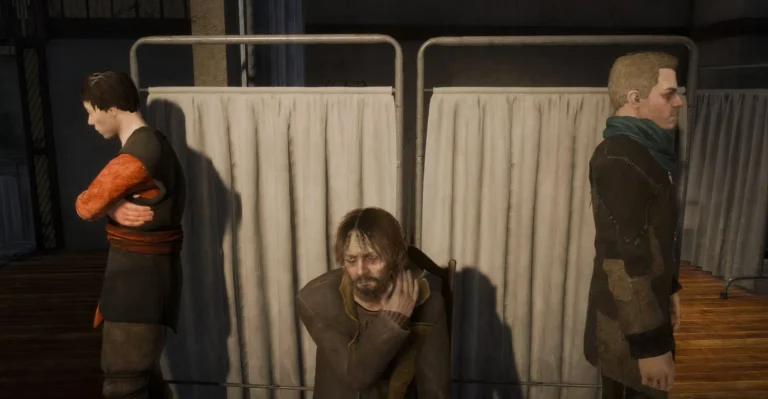
Starting on day four in Pathologic 3, you take on a new and very serious responsibility. You must diagnose patients suffering from intercurrent diseases. These illnesses do not cure the Sand Pest, but they slow it down. Every correct diagnosis matters because each success helps unlock a vaccine on the next day. If you misdiagnose patients, infection spreads faster and the game becomes much harder to survive.
This guide explains how the diagnosis system works in clear steps and shows you how to reach the right conclusion without guessing.
Pathologic 3: Hospital Patient Diagnosis Guide
How Patient Diagnosis Works
When a patient talks to you, you shouldn’t choose a disease right away. The first thing to do is collect the symptoms. Talking to the patient, doing visual examination, and doing the physical examination are the three ways to do that you do this.
When you talk to a patient, listen carefully to the dialogue options that talk about pain, weakness, or weird sensations. Some of the lines will let you talk about the symptoms and when this happens, it validates the symptom as real and trustworthy.
After this, look carefully at the patient’s portrait. Skin color changes, lumps, cuts, and weird spots are all visual symptoms. These are just as important as spoken hints.
Thirdly, do the physical examination of the patient. Sometimes this can bring out symptoms that were not in the dialogue. Make a note of each confirmed symptom in your casebook once you have detected it.
Narrowing Down the Disease
With all the available symptoms, the next step will be to compare them with the diseases that are known. Several diseases will often seem to be possible at first. This is totally normal. You are expected to limit the list, but not to instantly find the right disease.
If there is only one disease that matches all the symptoms noted, your diagnosis is probably correct. If two or more diseases still match, then you need more information to make your decision.
Using Biological Samples Correctly
When symptoms overlap, biological samples become essential. Each disease affects different organs. The disease information panel shows which organs are infected and which remain healthy.
You must identify which organs are affected in your patient and compare that with each possible disease. Even if two diseases share similar symptoms, they usually differ in organ impact. This is how you eliminate false matches and reach the correct diagnosis.
Skipping this step often leads to mistakes, especially later in the game.
When You Need to Investigate Outside the Hospital
Some cases cannot be solved inside the hospital alone. Patients may hint that something happened outside or that someone else knows more. When this happens, the game places a marker on your map.
You must visit that location and investigate. These field investigations can reveal new symptoms or remove incorrect disease options. Ignoring these prompts usually results in a wrong diagnosis.
Always treat outside investigation as part of the diagnostic process, not a side task.
Confirming the Diagnosis
Once you are confident, confirm the disease. A correct diagnosis helps slow the Sand Pest and contributes to vaccine progress for the following day. A wrong diagnosis wastes resources and pushes the town closer to collapse.
You are not punished immediately for a single mistake, but repeated errors quickly make survival much harder.
Patient Diagnoses by Day
In case you struggle, or you just want to concentrate on other parts of the game, we give you the confirmed diagnoses for every patient.
Day four brings about the Anemic Vasculopathy for Luta, the Burning Fever for Finch, and the Nephropathia epidemica for Filat.
By the next day, patient Bobok is found to have Burning Fever, patient Oktay is suffering from Stoneskin, and patient Sharp has been diagnosed with Consumption.
On day six, Hardman has Ink Syndrome, Gannet has Bradycardia, Grouse suffers from Steppe Gastrodermal Fever, and Burdock has Influenza.
On the seventh day, Tuutei is diagnosed with Ink Syndrome, Martin has Pulmomucous Syndrome, and Emilia suffers from Bonkowski’s Fever.
The following day, Petrel has Hepatitis, Astrild suffers from Measles, Tawpie has Tularemia, and Crow is affected by Steppe Dryness.
On day ten, Aristarkh has Hepatitis, Patchwork suffers from Measles, Sakh Man has Twyrine Syndrome, and Sergeant Dronte is diagnosed with Anemic Vasculopathy.
Final Diagnosis Tips
Do not rush your decisions, and instead, take your time. Always use the dialogue and the physical examination to confirm the symptoms before recording them. Whenever diseases overlap, use biological samples, and do not ignore the investigation prompts outside the hospital.
Pathologic 3 rewards careful thinking. If you treat diagnosis as a logical process instead of a guessing game, you will survive longer, unlock vaccines faster, and gain better control over the outbreak.