

How does a 15-year-old out-hit the best bowlers in the world?
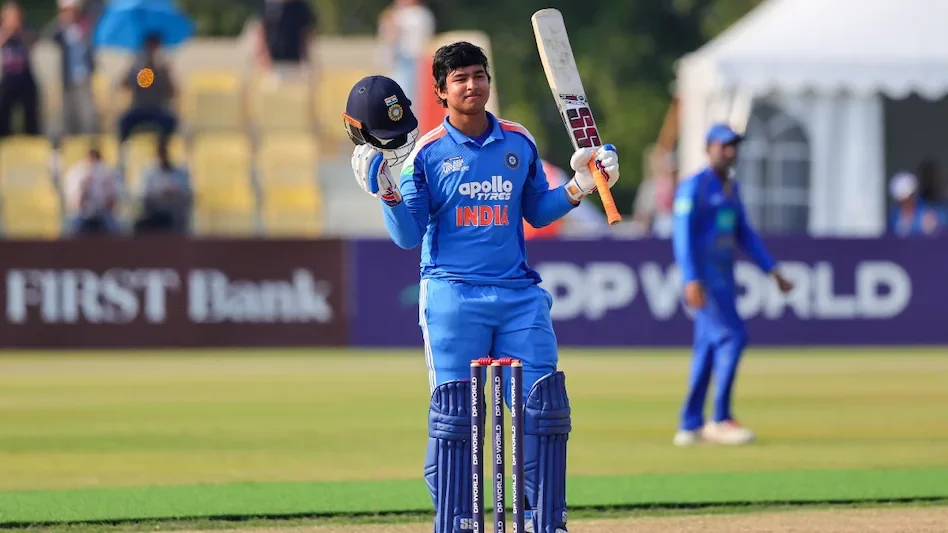
Vaibhav Sooryavanshi has made his India debut as the youngest male cricketer ever to do so. The experts who have studied him closely can explain a great deal, and then they run out of explanations.
Here is a puzzle worth sitting with. Vaibhav Sooryavanshi is 15. He is now the youngest male cricketer to play for India. And for two IPL seasons he has stayed ahead of some of the best bowlers in the world, who by the middle of IPL 2026 had spent months planning for him.
The Sachin Tendulkar comparisons were always going to arrive. But they don’t help much, because they tell us he is special without telling us why. So where does the power come from? And, the more interesting question, why does it keep working?
The view from the lab
Dr. Chris Peploe is a biomechanics researcher at Loughborough University. When he first watched Vaibhav Sooryavanshi, he reached for analogies that had little to do with cricket as we know it. “He turns forward momentum into rotational speed using an approach closer to baseball or golf than traditional cricket technique,” he says, “giving himself as much time as possible to accelerate the bat into impact.”
Julian Wood, Sri Lanka’s batting coach and one of the game’s leading power-hitting consultants, puts it more simply: “He looks very baseball-y to me.”
Baseball and golf feel like odd reference points for a cricketer. Watch him for a few overs, though, and the comparison starts to make sense. There is something undeniably physical about it, a power that seems to come from somewhere mechanical. Mark Butcher’s word for it was “violence”. During the IPL, Shreyas Iyer pointed to the flow of the bat and the momentum Sooryavanshi builds before the ball is even delivered. Shubman Gill singled out his hand speed.
Peploe, though, keeps coming back to one thing: the shoulder turn. At the top of the backswing, Sooryavanshi’s shoulders sit unusually closed relative to his hips, which creates what biomechanists call separation. The greater the separation, the greater the potential for rotational force once the body unwinds.
Built for time
The backswing itself is designed to buy time. Peploe points to the way Sooryavanshi’s hands work up and away from his body, lengthening the swing arc, while a pronounced wrist cock leaves the toe of the bat pointing skyward. “His bat goes past the vertical,” Wood says, “which is very difficult to control.” The upside is a swing with more time and distance to gather speed before impact.
Wood also likes the “hip hinge and spine tilt” in his setup, athletic positions that load the glutes and hamstrings, the body’s largest muscles, before the swing even begins. “Those are the fundamentals of power-hitting,” he says.
Then comes the part that Manish Ojha, Sooryavanshi’s childhood coach, thinks most viewers miss. “People think, wow, he’s a strong kid and must be hitting everything off the back foot. But you’re watching the final position and missing the sequence that got him there.”
The sequence, as Ojha describes it, is a transfer of weight from front to back, with the back shoulder central to the upward swing path that lets the teenager loft the ball so cleanly. Skip it and the line breaks down. “If he doesn’t go from front to back, he won’t be able to hold the line of the shoulder. That’s absolutely essential else he will finish with a half-shot over midwicket instead of finishing in line with the square leg umpire.”
On the downswing, Peploe highlights a “braced front side” that lets force travel through the hips and trunk before it is released through the arms and wrists. He offers a fast-bowling analogy: when a pacer hits the crease with a braced front leg, the lower body stops and the upper body flings forward over the top. “That’s how Vaibhav is converting weight transfer into rotation of his hips, shoulders and back.”
Even the finish is unusual. Ojha feels most batters end in a shape that resembles a “C”. Sooryavanshi’s often looks closer to an “O”, the bat travelling higher and finishing above the shoulder as the rotation carries through. For Peploe, this ability to rotate through impact is the “most outstanding” part of Sooryavanshi’s kinetic chain.
The trend, and the outlier
Step back and the picture gets bigger. Peploe sees Sooryavanshi’s mechanics as an “extreme example” of something already under way: modern batters building their games around rotational power, leg-side access and repeatable boundary hitting. Wood calls it “the future of T20 batting.”
Peploe is candid about the limits of his own comparisons. “I’ve never seen it before,” he says. Without data on the exact numbers a player like this can generate, he can’t measure Sooryavanshi against anyone he has studied, but “just visually, I’ve never seen anything like it.” He is sure the elite game feels the same way. “If you speak to the bowlers he’s coming up against, they just can’t believe what they’re seeing.”
And yet neither Peploe nor Wood is ready to call the mechanics revolutionary. They explain how he generates power, but not the scale of what follows.
Where do the mechanics stop?
“The outcome is the obvious outlier,” Peploe says. “Just the number and frequency of sixes he’s been able to hit.”
He has coined a phrase for it: “high-intent contact repeatability”. Plenty of players can generate bat speed and clear the rope in the modern game. What fascinates Peploe is that Sooryavanshi keeps swinging hard against elite bowling and still finds the contact quality needed to send the ball the distance.
Wood makes the same point from the coach’s side. “You get young players who burst on the scene and do it once or twice. Vaibhav has been relentless.”
Now the oddity. The IPL is full of athletes who are older, stronger and more developed than a 15-year-old. If consistency is his defining trait, physicality alone can’t be the explanation. Peploe follows the logic: “Comparing him physically to elite athletes who have been playing professional cricket for 10 years, he’s not as developed as them. He can’t be. So, I think, his point of difference has to be somewhere in his mental game, in his perception of the ball.”
Is it simply that he reads the ball earlier? Peploe doesn’t think so, or at least not only that. Part of the repeatability, he suspects, comes from simplification. “Because his intent is so clear, to hit every ball for a six, he’s not having to make as many decisions or choose from as many options as certain other batters. He’s making that decision earlier as a result of that, as much as reading where the delivery is actually going.”
Hours, and 500 balls
Ojha has a more earthbound explanation: work. He talks of travelling from Samastipur to Patna every alternate day and facing over 500 balls until every element of the kinetic chain became muscle memory.
But here is a detail that complicates the neat story. At his academy in Patna, Ojha says there are “at least 3-4 kids” from the same batch who can hit the ball comparable distances. “Maybe they will be here and there by 5-10 metres, but they regularly match Vaibhav on the distances they are able to hit.”
So raw hitting isn’t the separator. What those boys can’t replicate is where, and against whom, the shots are played. For Wood, that is as much about mindset as mechanics. “Fear of failure is massive, you know, and he hasn’t got that. He’s told, just go out and have fun. He’s been given the freedom to play. That’s so refreshing.” Ojha draws the same line: “Technique can be taught. The courage to hit cannot.”
Wood’s coaching philosophy fits neatly here. He would rather push players too far than not far enough. “I try to get them almost reckless. It’s easier to drag a player back than it is to get them going.” Keep stretching what a young player thinks is possible, he says, and “their ceiling will have gone up.”
That freedom shows in practice as much as in matches. After the IPL, Wood spoke to Dasun Shanaka, who shared a dressing room with Sooryavanshi at Rajasthan Royals. “He wanted the best bowlers bowling to him. And he would just destroy them,” Wood relays. “He’s basically training at the level that he’s playing at, if that makes sense.”
The weakness that wasn’t
Training against elite bowlers is one thing. Outthinking bowlers who have spent months plotting against you is another.
By the middle of IPL 2026, teams had largely settled on what looked like the obvious plan. His high backswing seemed to leave him exposed to full, straight balls. Bhuvneshwar Kumar, Kyle Jamieson and Pat Cummins were among those who tried it, Cummins even setting an unusually straight mid-off.
But as the season went on, the apparent weakness began to look like a problem Sooryavanshi was solving. After his Eliminator innings, in which he came within touching distance of Chris Gayle’s record for the fastest IPL hundred, Tendulkar noted how “beautifully he clears his front foot to create room for balls aimed at his legs” and how “this freedom allows him to play the way he does.”
Ojha believes the best batters aren’t those with no weaknesses but those who make them hard to reach. Peploe, for his part, is certain a flaw must exist. “There has to be, but the bowlers clearly haven’t found it yet.” Wood, with a smile, has a simpler theory: “Bowlers haven’t worked him out yet because they can’t.”
A Dhoni-shaped parallel
The idea takes Ojha back to another batter he watched for years from close quarters. He shared a dressing room with MS Dhoni for a decade in domestic cricket, and Sooryavanshi reminds him of him.
When Dhoni first emerged, Ojha admits, he never quite understood how he survived at the highest level. The defence didn’t look classical. Yet Dhoni made his mark in limited-overs cricket and went on to captain India in Tests, playing as many as ninety of them.
In hindsight, it makes sense. “It’s part of the skillset of great players,” Ojha says, “to not let bowlers exploit the loopholes in their batting. Before that, they find a way to attack and disrupt bowling plans.”
Will bowlers find more answers for Sooryavanshi? Almost certainly, much as they eventually did with Dhoni. They always do. But that still doesn’t explain how a 15-year-old stayed ahead of some of the best bowlers in the world across two IPL seasons, or why, as Wood puts it, “he could be 25 years old and you’d still go wow.”
What we can and can’t explain?
The biomechanics make sense. So do the years of repetition, the freedom with which he plays, and his ability to adjust when teams think they’ve found a way in. And yet every conversation that tried to explain him began with something measurable and ended somewhere less so. Shoulder turns gave way to perception, drills to courage, and mechanics to the plain admission that not everything can be explained.
Ojha, who has perhaps watched more of Sooryavanshi’s cricket than anyone except his father, is at peace with that. “Kuch toh ab bhagwan ki bhi den hai.” Some of it, he means, is simply a God-given gift.
Which may be the most honest answer available, for now.

Relevant news

From Punchline to Powerhouse: RCB Face a New Kind of Problem
For years, Royal Challengers Bengaluru were the punchline, a franchise defined by glamour and star…

Pakistan’s Test Rebuild: What the Sri Lanka Series Revealed About Their Future
Was this the end of a long, turgid Test year for Pakistan, or the beginning…
Australia’s Ball-Tampering Scandal Returns: How Two Weeks of Revelations Reopened the Wounds of 2018
It has been eight years since Australia's ball-tampering scandal in South Africa, but why does…
MS Dhoni: The Man Who Made the Difficult Look Simple, Through the Eyes of Those Who Played Alongside Him
Few cricketers have been watched as closely as MS Dhoni, and fewer have revealed so…
IPL 2027 Retentions: 184 Players Stay, but the Real Story Lies in the 66 Spots Still Available
With all ten franchises announcing their retained-player lists on November 18, the first major phase…
Australian Cricket’s Mateship Has Cracked: The Sandpapergate Fallout Is Now Bigger Than 2018
Mateship. What happens when the very value that is supposed to hold Australian cricket together…