

Mohammed Shami’s Test Retirement: A Career of Extraordinary Skill and the Unanswered ‘What If’
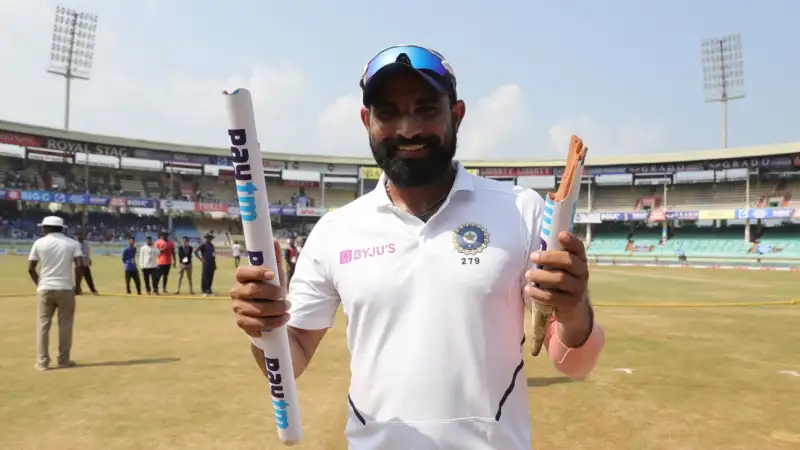
It took just 17 balls to capture the essence of Mohammed Shami’s Test career. In Johannesburg, on the fourth evening of the 2018 Test against South Africa, India were staring at a potentially disappointing defeat. The hosts were 157/5 in pursuit of 241, seemingly in control of the chase. Then Shami took over. With pace, precision and an old ball that seemed to have a mind of its own, he dismantled the lower order and turned a difficult situation into a 63-run Indian victory.
It was Shami in his element: relentless, aggressive and capable of producing something extraordinary when a match appeared to be slipping away.
Thirteen years after making his Test debut, Shami has brought that chapter of his career to a close. His retirement, announced on November 6, the same date as his Test debut 13 years earlier, invites a familiar question whenever a great fast bowler walks away: how much did he achieve, and how much more might have been possible?
His numbers are impressive. His influence on Indian fast bowling is arguably even greater. Yet, there is an unmistakable sense of incompleteness about a career that could have extended much further.
South Africa knew the damage Shami could inflict
South Africa were among the teams that experienced Shami’s ability to change a Test match more than once.
The Johannesburg performance in 2018 was an early illustration of his command of the old ball. Three years later, during India’s Boxing Day Test victory in Centurion, he produced another outstanding performance, taking a first-innings five-wicket haul. He troubled three of South Africa’s top five before returning to claim three more wickets in the second innings.
Between those performances came another memorable demolition, this time in Visakhapatnam.
During Virat Kohli‘s captaincy, India developed an increasingly aggressive approach to Test cricket. Kohli wanted his fast bowlers to attack, maintain pressure and make life uncomfortable for opposition batters. Shami fitted that philosophy almost perfectly.
In the second innings against South Africa in Visakhapatnam, he returned figures of 10.5-2-35-5. Those numbers tell only part of the story. One particular dismissal captured his ability to make even sensible batting decisions look disastrous.
Faf du Plessis shouldered arms to a delivery that appeared to be heading past his off stump. Instead, the ball seamed back in and knocked over the stumps. Du Plessis stood in disbelief.
That was one of Shami’s greatest strengths. He could make a batter question a decision that had seemed perfectly reasonable a moment earlier.
The science behind Shami’s unpredictability
What made Shami so difficult to negotiate?
A red ball leaving his hand always carried possibilities. It could seam away, move sharply back into the batter or reverse swing when conditions allowed. He could extract movement even without a particularly responsive surface, and his ability to manipulate the new ball was just as important as his work with an older one.
But perhaps the most remarkable feature of his bowling was something less dramatic: his seam position.
Shami’s upright seam was a product of extraordinary consistency. It remained straight and stable through his delivery, giving the ball the best possible opportunity to move in either direction. Slow-motion footage of his bowling often revealed a seam position that looked almost too perfect to be natural.
He combined that technical precision with pace, control and the physical endurance required to bowl long spells.
Reverse swing was another important weapon. As the ball aged, Shami could make it move in ways that created opportunities even when the pitch offered little assistance.
There was aggression in his bowling, but not necessarily in his behaviour. Shami was never particularly known as a sledger. Former India coach Ravi Shastri reportedly had ways of motivating him, including firing him up over a meal, but that intensity rarely translated into confrontations with opposition batters.
He celebrated wickets enthusiastically, sent stumps cartwheeling and occasionally broke them in two. Yet he generally remained a civilised bruiser, letting his bowling do the talking.
The numbers behind a remarkable Test career
Shami retires with 229 wickets from 64 Tests at an average of 27.71.
At home, his average was five points lower, underlining his effectiveness in Indian conditions. His record in Asia was particularly impressive. Among bowlers with at least 75 wickets, only Kuldeep Yadav and Waqar Younis have a better strike rate in the region than Shami’s 41.8.
His best Test figures were 6/56, achieved in Perth during India’s successful 2018-19 tour of Australia.
India lost that particular Test, but Shami once again demonstrated his ability to influence a match even when the team was under pressure. On a lively surface, his short deliveries and hard lengths troubled the Australian batters.
It was also part of a larger story about Indian cricket. For years, India had been recognised primarily for their batting strength and their ability to produce quality spin bowlers. Shami was among the fast bowlers who helped change that perception.
He could operate in demanding overseas conditions, bowl extended spells and return to trouble batters with an older ball. More importantly, he helped establish the belief that India could compete with the best batting sides through fast bowling rather than relying exclusively on spin.
The 2023 World Cup and the beginning of the ‘what if’
If there is one period that makes Shami’s retirement particularly difficult to process, it is the 2023 ODI World Cup.
He played through pain, managing a heel and Achilles injury with injections, yet remained central to India’s campaign. His performances were exceptional. Shami finished as the tournament’s leading wicket-taker, collecting 24 wickets in just seven matches.
That is an extraordinary return, particularly considering the physical difficulties he was managing.
His contribution helped India reach the final, reinforcing the impression that he remained one of the country’s most influential fast bowlers.
But the physical cost was significant.
Surgery followed in February 2024. The initial hope would have been that rehabilitation could bring him back to full fitness, but complications began to affect his prospects later that year.
Knee swelling during rehabilitation ruled him out of the Border-Gavaskar Trophy in Australia. It was a major setback, especially because India would have valued his experience and ability in challenging overseas conditions.
The injury also changed the trajectory of his remaining Test career.
Shami returned to red-ball cricket for Bengal in late 2024 and subsequently made his international comeback in the Champions Trophy 2025, ending a 14-month absence.
However, a return to Test cricket proved much harder.
Home series and overseas tours came and went, but the selectors remained reluctant to bring him back into the longest format. The concern was understandable. A recurrence of injury could leave India short of an experienced fast bowler during a demanding Test assignment.
Still, the question remained: if Shami was fit enough to return to international cricket, why was there no place for him in India’s Test plans?
Perhaps the selectors were looking at workload management and the risks associated with a bowler whose body had already endured considerable stress. Perhaps they wanted to invest in younger options. The precise reasoning is difficult to establish, particularly when team management and selectors do not always make every consideration public.
But from the outside, it was difficult not to wonder whether Indian cricket had lost the opportunity to see Shami in whites again.
Why 64 Tests feel like too few
There is something unusual about Shami’s retirement statistics.
Only five Indian fast bowlers have played more Tests than him. Sixty-four appearances over 13 years represent a substantial international career, and 229 wickets are an achievement that deserves considerable respect.
Yet, for a bowler of his quality, the numbers feel slightly short of what might have been expected.
An 80-plus Test career and 250-plus wickets would perhaps have been a more fitting reflection of his ability and appetite for the format.
This is where the distinction between performance and career longevity becomes important.
Shami had the skill to continue troubling international batters. His technical strengths did not suddenly disappear. His ability to generate seam movement, reverse swing and maintain pressure remained valuable attributes.
But fast bowling is not simply about skill. It demands a level of physical durability that can be particularly unforgiving over a long career.
The 2023 World Cup demonstrated what Shami could still produce at the highest level. The subsequent injury problems demonstrated how quickly those possibilities could disappear.
On November 6, he chose to complete the circle by announcing his retirement on the anniversary of his Test debut.
A fitting date, perhaps, even if the circumstances surrounding the decision leave plenty to reflect upon.
India’s fast-bowling future without Shami
Shami’s departure also raises a larger question about India’s next generation of Test fast bowlers.
Who can offer the same combination of seam presentation, control, reverse swing and persistence?
India have developed several quality pace options, but replacing a bowler is rarely about finding someone who can simply reproduce his wicket tally. Different bowlers bring different attributes, and the balance of a fast-bowling attack depends on how those attributes complement one another.
Shami’s particular value came from his ability to make things happen with both the new and old ball. He could attack the stumps, extract movement off the surface and exploit reverse swing. His persistence also allowed captains to use him through long spells without abandoning their attacking plans.
Finding another bowler who combines all those qualities will take time.
There is also a broader scheduling challenge. Modern international cricket requires players to move between formats, manage workloads and recover from increasingly demanding calendars. Fast bowlers face a particularly difficult balancing act because the physical demands of Test cricket are very different from those of limited-overs cricket.
Shami’s career offers a reminder that even exceptional skill cannot always overcome the demands placed on a fast bowler’s body.
A legacy bigger than 229 wickets
It would be easy to judge Shami’s Test career through averages, strike rates and wicket tallies. Those figures establish his quality, but they do not fully explain his contribution.
His legacy perhaps lies in the way he helped change India’s relationship with fast bowling.
He was part of a generation that made India’s pace attack a genuine weapon overseas. He showed that Indian fast bowlers could bowl long spells, exploit old-ball conditions and repeatedly threaten established batting line-ups.
He was not the first Indian fast bowler to achieve that, and he certainly will not be the last. But his consistency and technical excellence helped establish a standard for those who followed.
The search for his successor will not be straightforward. Finding someone with his seam presentation alone will not be enough. India will need a bowler who can combine that skill with the physical endurance, control and understanding of reverse swing that the longest format demands.
That process may take years, and a fair amount of luck.
For now, Shami’s time in whites is over. The red ball is no longer his responsibility.
But Test cricket has a habit of bringing memories back. When the light begins to fade, the ball gets older and reverse swing starts to become a factor, or when a seemingly ordinary length delivery moves just enough to beat a batter’s judgement, it will be difficult not to think of Mohammed Shami.
A career of 64 Tests, 229 wickets and an average of 27.71 is already an impressive achievement.
What makes it more compelling, however, is everything that might have followed.
The talent was there. The skill was there. The appetite was rarely in doubt. But injuries, rehabilitation setbacks and the changing demands of international cricket had their say.
A lot went into Shami’s Test journey. Much of it was extraordinary, much of it difficult to explain, and some of it was beyond his control.
The final chapter may have arrived earlier than many would have liked. But the memories of what he could do with a red ball will remain long after his last delivery.

Relevant news

Malloy Takes Over as NZC Chair as Puketapu-Lyndon Departs
Kevin Malloy has been elected Chair of New Zealand Cricket, succeeding Diana Puketapu-Lyndon, who stepped…

Randell Earns Maiden New Zealand Call-Up as Injuries Force Changes
New Zealand have handed a maiden international call-up to 31-year-old pacer Brett Randell for the…
Smog Forces Second Pakistan-Sri Lanka Test Out of Lahore
Rawalpindi: The second Test between Pakistan and Sri Lanka has been relocated from Lahore to…
New Zealand Recall Ravindra, Conway and Blundell for India Tests
Wellington: New Zealand have named a 14-man squad for the two-Test series against India beginning…
Cricket Scotland Joins Australia and England in Afghanistan Boycott
Cricket Scotland has confirmed it will not schedule any fixtures against Afghanistan outside of ICC…

Rain Ends India A Test in Lincoln as Batting Rivals Make Their Case
Lincoln: The third unofficial Test between New Zealand A and India A ended without a…